Two AIs, one division of work, and the line that matters
A role belongs to this round of work, not to the model. Connecting is one thing, permission is another, and human release is a third.
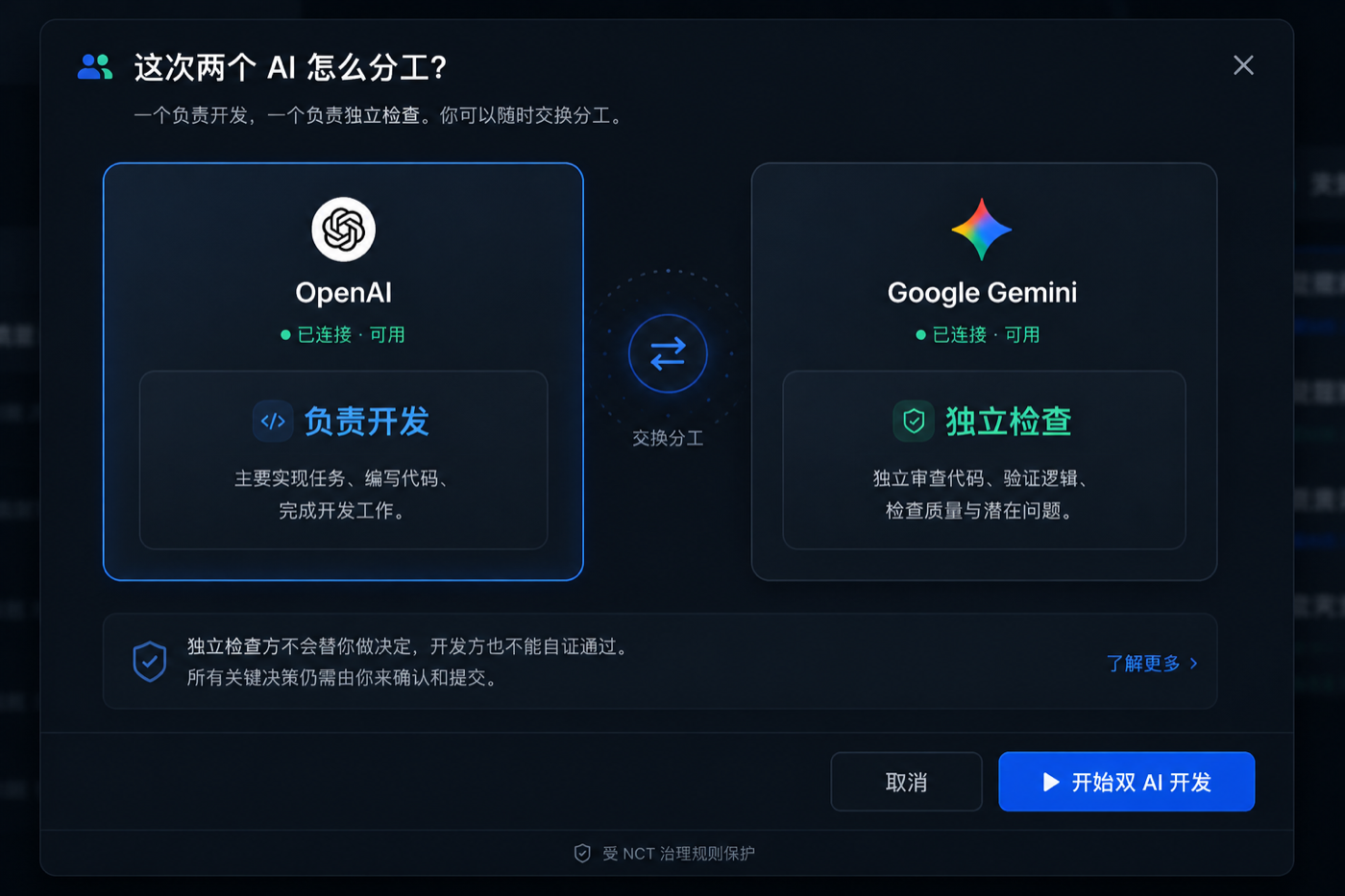
These two screens say more about the system than anything else I could show. So here they are.
The words "this time"
The heading on the role dialog reads: How should the two AIs divide the work this time?
Not "Configure AI roles." Not "Choose your development assistant." This time.
Those two words carry a rule: a role belongs to this round of work. It does not belong to the model.
OpenAI is not "the builder." Gemini is not "the verifier." The same model can build in one round and verify in the next — but every change of role has to re-establish its own context, session and authority boundary.
The swap control in the middle is not there for convenience. It is the physical form of that rule: you can see at a glance that the two roles are interchangeable, so neither can be permanently bound to a model.
If the heading said "Configure AI roles," the role would become a property of the model. One word, and the architecture is already wrong.
Two AIs are not there to agree
The line under that dialog reads:
The independent reviewer does not decide for you, and the builder cannot certify itself. Every key decision still has to be confirmed and submitted by you.
Two AIs are not put together so they can nod at each other. They are put together so that neither one can declare its own work accepted.
Agreement is not correctness. Two models that can see each other's reasoning will happily reinforce the same wrong assumption. So independent analysis has to stay independent, synthesis organizes rather than judges, and a human adjudicates.
The provider center
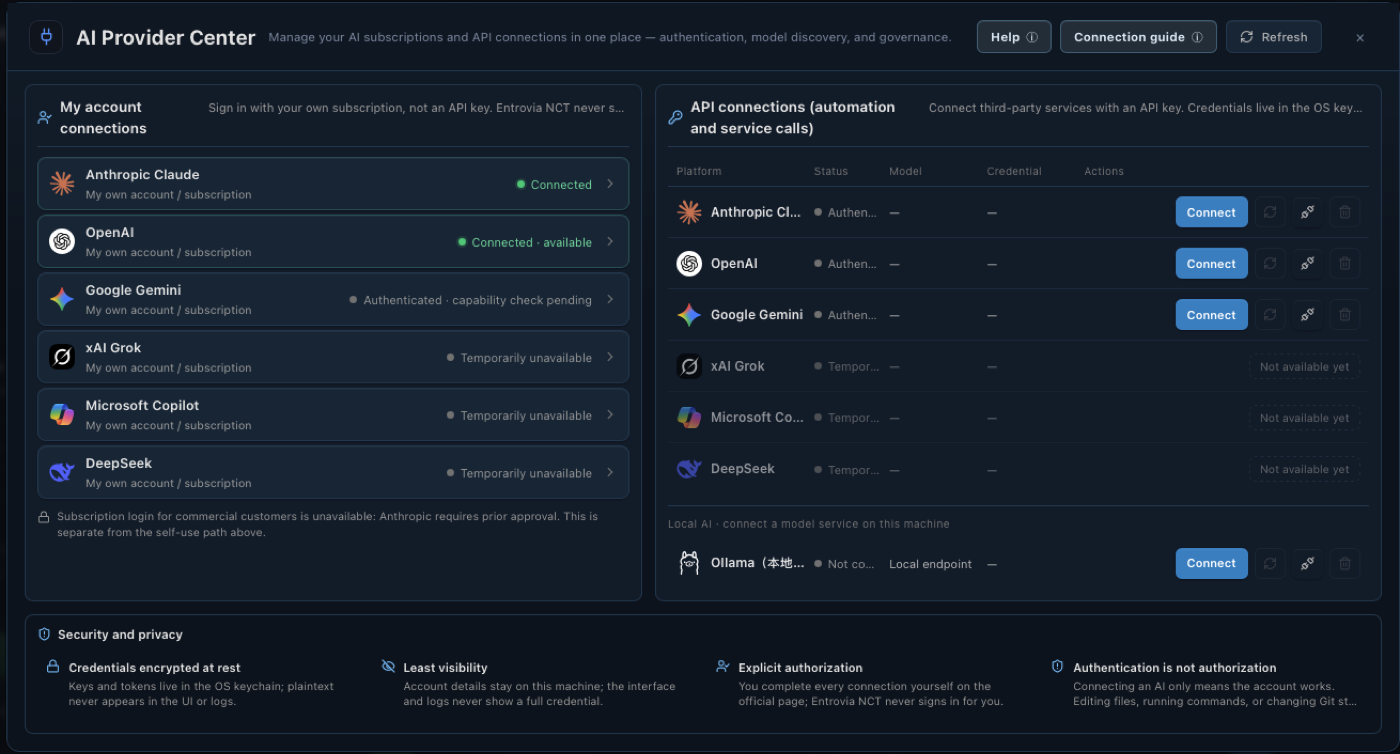
The second screen manages accounts and connections.
On the left are my own subscriptions — Claude, OpenAI and Gemini connected; Grok, Copilot and DeepSeek not available yet. On the right are API connections for automation and service calls. Below that, Ollama, for a model running on this machine.
NCT does not sell AI and does not resell tokens. You bring your own account and your own quota.
The four rules at the bottom of that screen:
Credentials encrypted at rest — keys live in the OS keychain; plaintext never appears in the UI or logs.
Least visibility — account details stay on this machine; the interface and logs never show a full credential.
Explicit authorization — you complete every connection yourself on the official page; NCT never signs in for you.
Authentication is not authorization — connecting an AI only means the account works. Editing files, running commands or changing Git state still needs your explicit authorization.
The last one is the foundation
A model being connected, capable and convincing does not prove it should be allowed to change your work.
Connecting is one thing. Permission is another. Human release is a third.
In NCT those three never collapse into one.