The best engineers beside you — and an AI that remembers and doesn't drift.

Most people have something they never got to build — not for lack of ideas, but because nothing holds the line. Direction drifts, the AI wanders, and you can't tell what's still true. NCT holds the line, so what you build stays what you meant.

Built for a world where AI changes everything, and control changes nothing.

Engineering control system for governed AI development, canonical engineering reality, RCA, evidence, context continuity, technical debt and human authority.

The best engineers beside you — and an AI that remembers and doesn't drift.
THREE SYSTEMS · ONE CORE

The core came third. That is the whole argument.

NGF and NAO are two heavyweight commercial systems, written by one person, for real businesses. Building them alone is what made the missing layer impossible to ignore: direction drifted, the AI reported success it had not earned, and nothing existed that could prove what was actually true. NCT is that missing layer. It now governs its own development, and the other two are migrating into it.

NCTEngineering foundation

Native Control Tower

Engineering reality, under control.

Defines how complex software is understood, changed, verified, recovered and remembered.

Active Development · Self-Bootstrap — Active development. NCT is being used as the migration target for its own future development workflow.

NGFEnterprise foundation

Native Governance Fabric

Weave your enterprise truth.

A governance foundation for keeping business rules, operational reality and accountable decisions aligned across a growing enterprise.

In Development · ~60% Complete — Paused for NCT migration. Development resumes inside NCT once the minimum safe integration point is reached.

NAOOperations foundation

Native Autonomous Orchestrator

Connect the business. Stop using people as glue.

A visual operating layer for coordinating complex, high-coupling workflows without relying on manual glue between people and systems.

In Development · ~45% Complete — Paused for NCT migration. Development resumes inside NCT once the minimum safe integration point is reached.

A control system designed on a whiteboard is a theory. This one was extracted from what it actually takes to deliver two commercial systems with no team, no code review, and nobody to catch the mistakes. NGF and NAO are not a detour from NCT — they are the reason it exists, and the first two systems it has to prove itself on.

SELF-BOOTSTRAP

It builds the other two. It also builds itself.

The hardest test of a control system is not whether it can govern someone else's work. It is whether it can govern the work of building itself — because there is nobody to exempt you, and no version of the truth that is not yours. Every rule on this site is applied to NCT's own development first. When the system refuses to accept a task, the founder does not get to overrule it because he wrote it.

In compilers this is called bootstrapping, and it is the moment a tool stops being a demonstration. It is also the sharpest way to be proven wrong: if the discipline did not hold, it would break here first — on the one person with every reason and every ability to bypass it.

Every claim on this site has a proof entry behind it — what the evidence is, and whether it can be shown. Some of it you can recount yourself.

Evidence →

By 2028 Gartner expects 90% of enterprise software engineers to be using AI code assistants. Gartner also expects 40% of enterprises may decommission AI agents they already deployed — because governance failed. That gap is the market NCT is in.

The market figures, with sources →
THE SHIFT

You can't govern something that drifts with something else that drifts.

More AI means more can be generated. It does not mean more can be proven. Adding a second or a third model raises the odds of catching a mistake; it does not change the structure. The layer that governs has to be deterministic, and it has to grow as fast as the models do.

  • AI Self-Report ≠ Acceptance
  • Permission ≠ Authority ≠ Human Gate
  • Test Green ≠ Business Correct
  • Actual ≠ Approved
  • Prediction ≠ Fact
  • No Measurement ≠ Measured Zero
THE LAWS WE DON'T BEND

These are not our opinions. They are the rules we refuse to break.

On AI

You can't govern something that drifts with something else that drifts.

So the layer underneath has to be deterministic. Adding a second or third AI raises the odds of catching a mistake. It does not change the structure.

An AI saying “it's done” is exactly as cheap as saying “I was wrong.”

So completion is never declared by whoever did the work. A claim needs evidence, and the evidence has to survive an independent re-run.

The stronger the model gets, the harder the layer underneath has to be.

A stronger model proposes more, reaches further, and sounds more convincing. Observability, constraint, authority, state and recovery have to grow with it. This is control theory, not a slogan.

On numbers

Where we haven't measured, we write UNKNOWN. We don't write 0.

No measurement is not the same as a measured zero. Every number on the screen has to be able to say where it came from.

What isn't recorded today cannot be recovered later.

So the entry tier records the same base facts as the top tier. An upgrade unlocks interpretation, never history.

Half-finished is never painted green.

Partial success is more dangerous than total failure, because part of reality has already changed and nobody is looking at it.

On people

Being allowed to click the button is not the same as having the right to make the decision.

Permission, Authority and Human Gate are three different things. They are never allowed to collapse into one.

“Everyone has always done it this way” is not the same as “the company approved it.”

Actual, intended and approved are kept apart. A deviation is governance information, not noise to be smoothed over.

Technically possible to automate is not the same as entitled to automate.

We don't build systems to replace people. People are part of the governance structure, not a cost waiting to be optimized away.

Entropy is the road, not the enemy.

Anything that keeps running produces entropy — people change, rules age, reality drifts away from the plan. That is not the danger. The danger is entropy you cannot see, cannot audit and cannot prove.

WHY NOW

AI made change cheap. It did not make engineering reality simple.

As humans and multiple AI systems change software in parallel, the hard problem becomes preserving what is true: what was intended, what changed, what failed, what was proven, who had authority, and what must survive the next session.

  • Software development used to lose state between people. AI increases the speed and number of changes, but also multiplies the number of decisions, assumptions and handoffs that can drift away from reality.
  • NCT controls the relationships, not just the editor. The system keeps intent, participation, authority, change, proof, failure, recovery and memory connected instead of leaving them inside a temporary AI conversation.
PROJECT-OWNED MEMORY

The disk can move. The project's memory can't be lost.

A project can live on an internal drive, an external disk, an SD card, a NAS or a disk array. Where it is stored is not what it is. Once NCT has read it, the engineering facts — decisions, requirements, failures, RCA, evidence, recovery, handoff position — belong to the project and stay recoverable, whatever machine, tool, window or AI provider comes next.

  • Storage location is not project identity.
  • Changing AI does not mean re-telling the project's history.
  • Recovery restores more than files — it restores why it was changed.
  • Current reality and historical reality stay apart.
  • The next task only receives context it actually needs and is entitled to.
MORE INTELLIGENCE · SAME HUMAN CONTROL

AI is a governed resource — not the project authority.

NCT can expand the intelligence around a problem without silently expanding execution authority. Models can be selected, assigned, isolated and replaced while human authority and project truth remain separate.

  • AI output is a candidate, not project truth.
  • Permission, authority and human acceptance remain distinct.
  • Independent analysis is valuable only when independence is preserved.
  • Complex machine work should return to a form a human can understand and decide.
ONE ENGINEERING REALITY · MANY LENSES

The same project can answer different questions without creating different truths.

A developer, technical lead, architect, reviewer or executive should not need separate versions of reality. NCT projects the same underlying engineering facts at the depth and perspective each responsibility needs.

  • Developer · What do I safely change next?
  • Lead · What is blocked, risky or unproven?
  • Architect · What relationships and constraints are changing?
  • Reviewer · What evidence actually supports the claim?
  • Executive · What is real, what is at risk, and what decision is needed?
WHAT NCT PRESERVES

The project remembers. Intelligence stays replaceable.

NCT is built around a durable engineering reality: identity, relationships, evidence, authority and memory survive beyond any one AI session or machine.

  • Portable Engineering Reality — Move the project. Keep the engineering history. Changing AI, workspace, machine or project location should not erase what the project already learned. Stable project identity and resolvable references let recorded engineering facts remain recognizable, verifiable and reconstructable as the project moves. PATH ≠ IDENTITY · HASH ≠ TRUTH
  • Engineering Memory — The AI can forget. The project should not. Temporary AI context is a terrible place to keep durable engineering decisions. Decisions, RCA, evidence, debt, recovery and outcomes belong to project history while task sessions remain temporary. PROJECT REMEMBERS · AI TASK SESSION FORGETS
  • Governed Intelligence — Intelligence can propose. It cannot quietly become authority. A model being connected, capable or confident does not prove it should read, write, push or approve. Provider, role, context eligibility, permission, authority and Human Gate remain separate facts. PERMISSION ≠ AUTHORITY ≠ HUMAN GATE
  • Independent Analysis — Agreement is useful. Independence is more valuable. Multiple AIs can amplify the same assumption when they see each other’s reasoning. NCT’s architecture supports isolated analysis where peer outputs stay hidden, synthesis organizes rather than judges, and humans adjudicate. CONSENSUS ≠ TRUTH · CONSENSUS ≠ AUTHORITY
  • Evidence & Acceptance — Done is not a sentence. It is something you can prove. A green-looking status or an AI claim can hide missing tests, stale evidence or an unverified change. Tests, evidence, provenance, version identity and human acceptance remain connected but distinct. AI SELF-REPORT ≠ ACCEPTANCE
  • Record Once, Interpret Forever — Capability can arrive later. History cannot. If foundational facts were never recorded, a future upgrade cannot reconstruct the past honestly. One core records the foundation; deeper entitlement can unlock richer interpretation without inventing history. UPGRADE UNLOCKS INTERPRETATION, NOT HISTORY
DEPTH

The surface stays simple. The system underneath gets deeper.

NCT does not add a new product every time the problem becomes harder. The same engineering reality gains more relationships, proof and memory.

  • Project Reality — Know what exists before changing it. NCT starts from the current engineering state, not from an AI conversation. Project identity, files, code, Git reality, requirements, health, known/unknown boundaries and current-versus-historical facts remain distinguishable before any mutation begins. Reality before action · Current state before mutation · Known / Unknown stay explicit · Observer ≠ Development
  • Engineering Relationships — See what a change is connected to. A file change is interpreted in context: architecture decisions, contracts, dependencies, boundaries, requirements, evidence and prior failures can remain connected through one engineering relationship fabric without creating a second source of truth. Change is never just a file · Object truth stays with its domain · Relationship carries provenance · Impact is not authority
  • Failure → RCA → Debt — A green test is not the end of the story. A passing test can still hide the wrong cause. NCT keeps failure evidence, RCA, recurrence, technical debt, operational impact and repayment triggers connected so repeated local patches can surface an architecture-level problem instead of being forgotten. Failure becomes durable knowledge · Symptom ≠ root cause · Debt keeps operational meaning · Trigger ≠ execution authority
  • Evidence & Authority — AI can propose. Reality must still be proven. NCT separates what an AI claims from what engineering reality can prove. Tests, raw results, version binding, evidence, permission, authority, Human Gate and acceptance remain distinct so a convincing answer cannot silently promote itself into project truth. AI self-report ≠ acceptance · AI self-report ≠ acceptance · Permission ≠ authority · Evidence remains traceable
  • Continuity & Evolution — The session can end without the engineering thought state disappearing. Project memory survives the end of a task session. Decisions, superseded facts, RCA, debt, handoff position, recovery, evidence and outcomes remain project-owned history, while each new AI task receives only the minimum sufficient context it is authorized to use. The AI can forget. The project should not. · Project remembers · Task sessions can reset cleanly · Historical truth ≠ current truth
FAILURE SHOULD COMPOUND INTO KNOWLEDGE

A failure should make the next decision better.

NCT keeps failure, evidence, root-cause reasoning, technical debt, repair and later outcomes connected so repeated local fixes can surface a structural problem instead of disappearing into chat history.

Same facts. Same evidence. Same history. Different people ask different questions — and nobody gets a private version of the truth.

ENGINEERING DEPTH

The deeper the problem, the more NCT connects — without making the human operate the whole machine.

From project reality to relationships, RCA, evidence and continuity, the same core grows inward rather than multiplying products and dashboards.

Capability depth and workspace are orthogonal.

L1–L5 answer how deeply NCT can understand and govern engineering reality. W1–W3 answer where a person works. A deep L5 engine can still return a simple result to a developer in W1.

Six public capability surfaces. One reality underneath.

REAL PRODUCT · CURRENT SURFACES

See the control system, not a pitch-deck reconstruction.

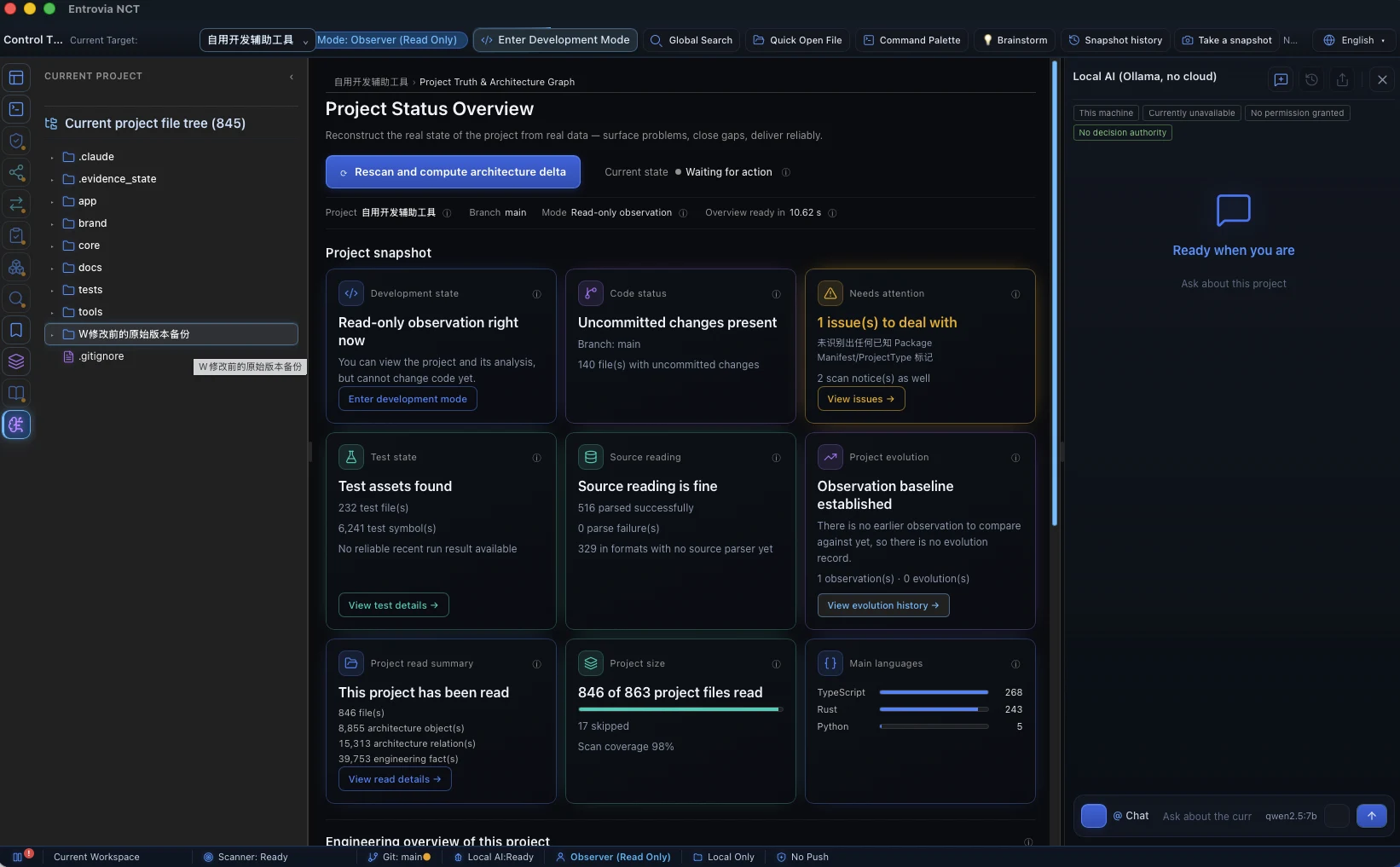
The website uses current NCT product surfaces to explain how project reality, AI participation, health, evidence and engineering context are governed.

INCUBATOR / PRIVATE REVIEW

See the control system against a real engineering problem.

NCT is being built as infrastructure, not a demo narrative. The private review is designed around real project reality, governance, evidence and recovery.

ENGINEERING EVIDENCE · CONTENTS PRIVATE

A continuous engineering evidence trail.

A continuous engineering evidence trail exists across NCT development — covering implementation, verification, independent acceptance, closure and subsequent iteration. Internal evidence remains auditable; sensitive contents are not publicly disclosed.

  • NCT engineering evidence Active development · self-bootstrap Implementation, verification, independent acceptance, evidence, closure and subsequent iteration remain traceable as one continuous engineering record.
  • NGF development evidence ~60% complete · paused for NCT migration A separate development record exists for NGF. Its internal evidence remains auditable and is not publicly disclosed.

Development → Verification → Independent Acceptance → Evidence → Closure → Next Iteration

Sanitized evidence archive Structure shown. Contents intentionally obscured. · OWNER_EVIDENCE… · INDEPENDENT_ACCEPTANCE… · VALIDATOR… · RCA… · CLOSURE… · NEXT_ITERATION…

Public proof is limited to existence, continuity and structure. Internal evidence contents, proprietary mechanisms and private information remain undisclosed.

I have the evidence. Do you want it? Every closure has a full evidence package — commands, changes, tests, failures, hashes, independent acceptance. They are not published, because publishing them would expose internal mechanisms and customer material. Ask, and we decide what can be shown. Disclosure follows the public / private boundary above. What can be shown is decided case by case.
FOUNDER

I built the control tower first, because there was no one to catch my mistakes.

For years I sat where the money had already been spent and the system was already live, and no one could prove it was working. Then I came to the United States and started building. There is no team here — I am the only developer I know. Architecture, governance, RCA, evidence, interface, across all three systems: one person carried it. So I built the control tower before the features, because I had nobody to catch me when I drifted. Now it catches me. What I want is simple. The thing that exists only in your head — you should be able to build it, with the best engineers standing beside you the whole way. That is what this is. When you use it, I am standing there too.

Head of ITPre-opening Team · Head of ITHead of IT Operations AuditHead of IT Solution Delivery

Where the discipline came from.

Head of Project ITHead of Hotel Pre-openingHead of IT Solution DeliveryIT Auditor
Worked inRitz-Carlton · JW Marriott · Accor · Pullman · Novotel
In the U.S.Licensed business owner and operator, 10 years
Experience15+ years
  • Conceived, architected and developed by one founder — no engineering team and no institutional funding.
  • Built through native-language natural-language development; the founder has not typed development commands or manually created project files.
  • AI is the construction medium. Product intent, architecture, definitions, decisions, orchestration, judgment and acceptance remain founder-owned.
  • Background spans enterprise IT, complex hospitality technology, pre-opening delivery and hands-on U.S. business operations.
  • More than 15 years across technology and operations, including Ritz-Carlton, JW Marriott, Accor and Pullman environments.
  • One developer independently drove three heavyweight software systems from architecture into real implementation
  • Entrovia NCT has crossed into self-bootstrap redevelopment and is used to govern the continued development of the control tower itself
  • NCT is being used while two other heavyweight commercial systems continue active development
  • The same founder carries product architecture, engineering governance, implementation coordination, RCA, evidence discipline and interface decisions
  • The development loop repeatedly converts failure → RCA → correction → evidence → reusable architecture
  • The product is being tested against the exact engineering pressure it is designed to govern, not only against presentation demos

Problem → Observation → Abstraction → Architecture → Build → Failure → RCA → Correction → Evidence → Next abstraction

  • 3 THREE HEAVYWEIGHT SYSTEMS
  • SELF SELF-BOOTSTRAP
  • 2 ACTIVE COMMERCIAL SYSTEMS
  • 1 CANONICAL CONTROL SYSTEM
  • RCA FAILURE → EVIDENCE → ARCHITECTURE

The differentiator is not that one person worked hard. It is that repeated engineering pressure across three heavyweight systems was converted into reusable control architecture, then used to govern the next development cycle.

  • Three systems, one engineering discipline The same founder carries product architecture, engineering governance, implementation coordination, RCA, evidence discipline and interface decisions across three heavyweight systems.
  • Self-bootstrap is already underway NCT has crossed from being built externally into governing the continued redevelopment of NCT itself — the product is increasingly tested against the exact development pressure it was designed to control.
  • The control system is being reused While NCT continues to mature, the same control-tower approach is being used to advance two additional heavyweight commercial systems instead of remaining a presentation-only prototype.